Skip to content
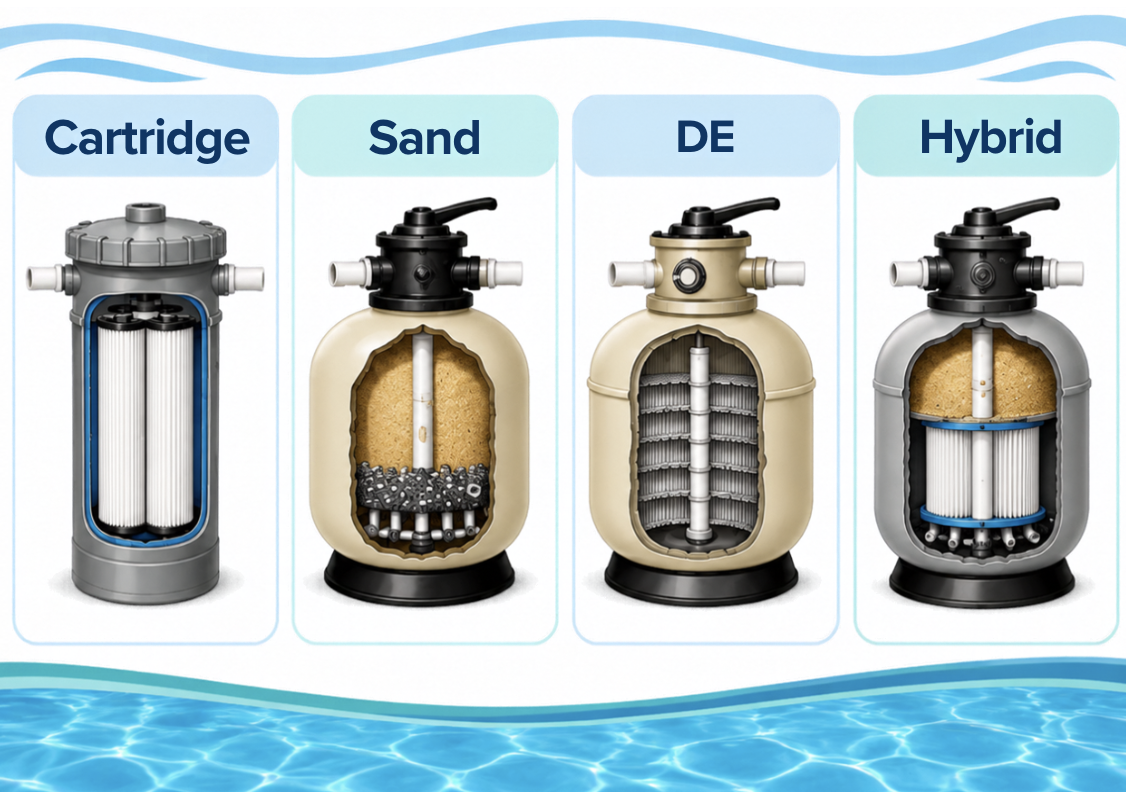
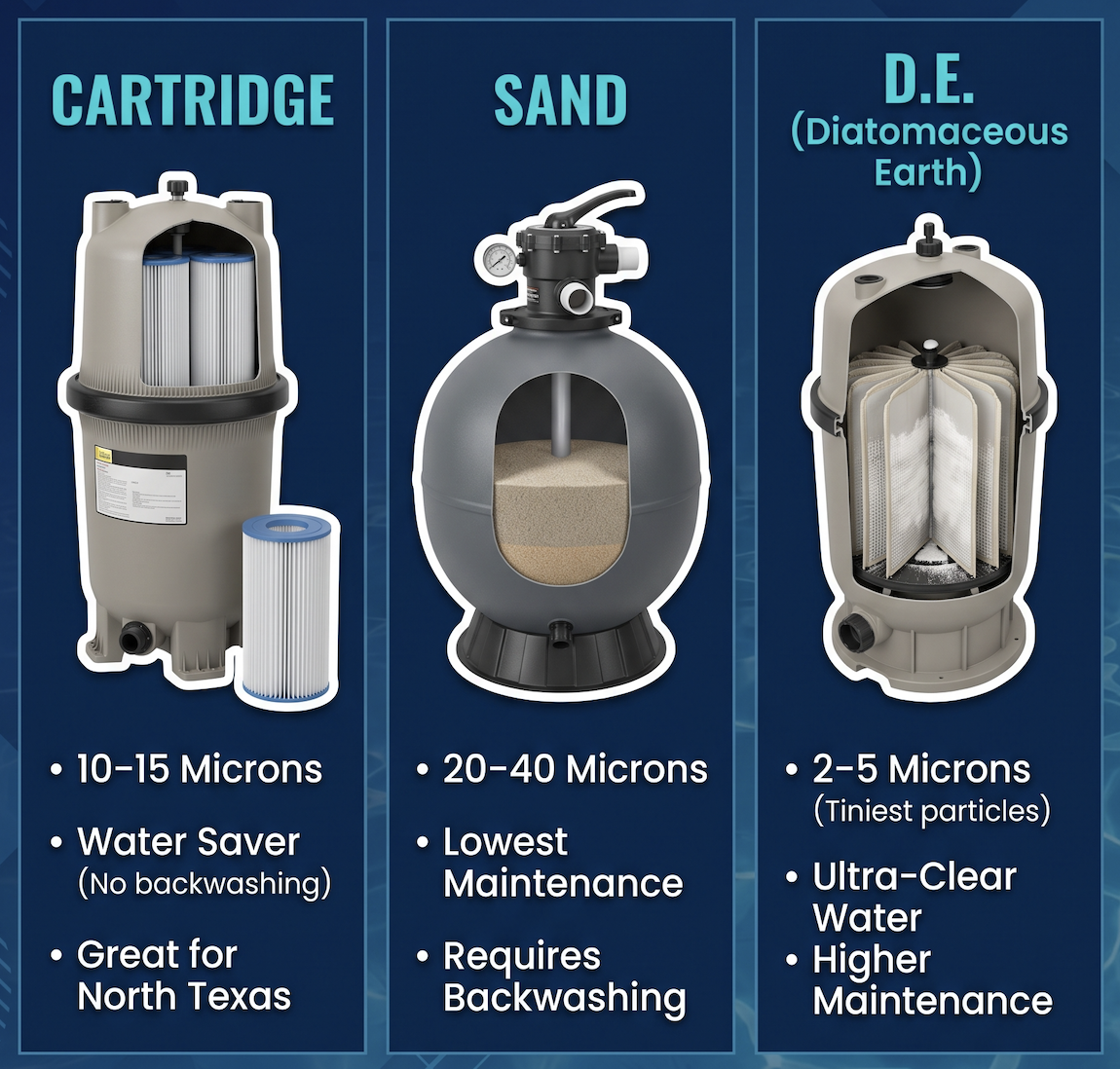
Quick answer: Residential pools use three main filter types. Cartridge filters catch the finest debris (down to roughly 9–10 microns, about 2–3x finer than sand) and never need backwashing, but they have to be pulled apart and cleaned by hand. Sand filters are nearly impossible to break but filter the least and need backwashing almost weekly. DE filters offer the finest filtration of the three with more upkeep. Most North Texas pool owners land on cartridge or DE. Hybrid and “bump” filters are niche products you generally do not need.
Your filter and pump are the two pieces of equipment that decide whether your water stays clear between visits. Noah’s Pool Service works on all three filter types every week across Fort Worth and the mid-cities, so here is his honest take on each one.
Start with the pump: the heart of the system
Before comparing filters, it helps to know what the filter pump actually does. If your pool had a heart, this would be it.
A good pump has to do three things: prime itself, move enough gallons per minute for your pool’s size, and keep pushing water through a filter that is getting dirtier every day. Circulation is what carries sanitizer behind the pool light, into corners, and through the dead spots where algae starts. A great filter behind a weak pump still gives you cloudy water.
Cartridge filters
How it works: Water passes through pleated fabric cartridges that trap debris. No backwash valve, no media to replace on a schedule.
Pros
- Filters two to three times finer than sand, down around 9–10 microns.
- Simple design with few moving parts.
- No backwashing, so no water loss and no wasted chemicals going down the drain.
- Versatile: works well for spas and indoor pools where you cannot backwash.
Cons
- You cannot backwash it. Cleaning means shutting the system down, opening the tank, and rinsing or soaking the cartridges by hand.
- Capacity matters. An undersized cartridge filter on a large pool clogs fast and needs cleaning constantly.
- Cartridges are a wear item and eventually need replacing.
Best fit: Most residential in-ground pools, especially if you want clear water without weekly backwashing. Size it generously.
Sand filters
How it works: Water is pushed down through a bed of filter sand. Debris gets trapped between the grains, and you reverse the flow (backwash) to flush it out.
Pros
- Nearly impossible to break. A sand filter forgives neglect better than anything else on the market.
- Cleaning is a valve turn, not a teardown.
- Low cost to maintain over its life.
Cons
- The weakest filtration of the three types. Fine particles pass right through, which is why sand-filtered pools often look a little hazy.
- Backwashing almost every week during swim season.
- Constant water loss and chemical loss every time you backwash, which in North Texas also means adding more hard tap water back in.
Best fit: Owners who value simplicity over water clarity, or pools with heavy debris loads where frequent backwashing is convenient.
DE (diatomaceous earth) filters
How it works: A powder made from fossilized diatoms coats a set of grids inside the tank. The DE does the filtering and catches very fine particles.
Pros
- The finest filtration available for a residential pool.
- Polished, sparkling water when it is maintained.
Cons
- Backwashing plus recharging with fresh DE every time.
- Grids need periodic teardown and cleaning, and DE powder must be handled carefully.
- More steps than either of the other two, so it rewards a consistent weekly routine.
Best fit: Owners who want the clearest possible water and have (or hire) a consistent maintenance routine.
Hybrid and bump filters: do you need one?
Hybrid filters combine a cartridge with DE, and bump filters use a handle to knock DE off internal fingers instead of backwashing. Noah’s take: if you want DE-level clarity, a standard cartridge filter with a small amount of DE added gets you most of the way there without buying a niche product. Bump filters are on their way out of the market, so parts and support get harder to find every year.
Watch next:
Side-by-side comparison
| Cartridge | Sand | DE | |
|---|---|---|---|
| Filtration fineness | Fine (≈9–10 microns) | Coarse | Finest |
| Backwashing | None | Almost weekly in season | Yes, plus DE recharge |
| Water loss | None | High | Moderate |
| Hands-on cleaning | Teardown and rinse | Rarely | Teardown and grid cleaning |
| Durability | Cartridges wear out | Very high | Grids wear out |
| Best for | Most residential pools | Simplicity, heavy debris | Maximum clarity |
What this means for weekly service
Whichever filter you own, it only works when it is clean and the pump is moving enough water. That is why filter pressure and pump performance are checked on every Noah’s Pool Service visit, and why a full filter cleaning is scheduled before pressure climbs high enough to strain the pump. If you would rather not think about any of this, our weekly service plans handle it for you.
Want a quote without an appointment? We can size up most pools from satellite imagery. Call or text 817-269-4520.
Frequently asked questions
What is the best pool filter type for a residential pool?
For most residential in-ground pools, a properly sized cartridge filter is the best all-around choice. It filters two to three times finer than sand, never needs backwashing, and is simple to maintain. DE filters give the clearest water but need more upkeep.
Is a cartridge filter better than a sand filter?
For water clarity, yes. Cartridge filters trap particles down to roughly 9–10 microns, while sand filters let fine debris through. Sand filters win on durability and forgive neglect better than any other type.
Can you backwash a cartridge filter?
No. Cartridge filters have no backwash valve. To clean one, you shut off the pump, open the tank, and rinse or soak the cartridges by hand.
How often does a sand filter need to be backwashed?
During swim season, most sand filters need backwashing almost every week. Backwashing sends water and chemicals down the drain, so the pool also needs topping off and rebalancing afterward.
Do I need a hybrid or bump pool filter?
Usually not. A standard cartridge filter with a small amount of DE added delivers similar clarity without a niche product. Bump filters are being phased out of the market, which makes parts harder to find.