Skip to content

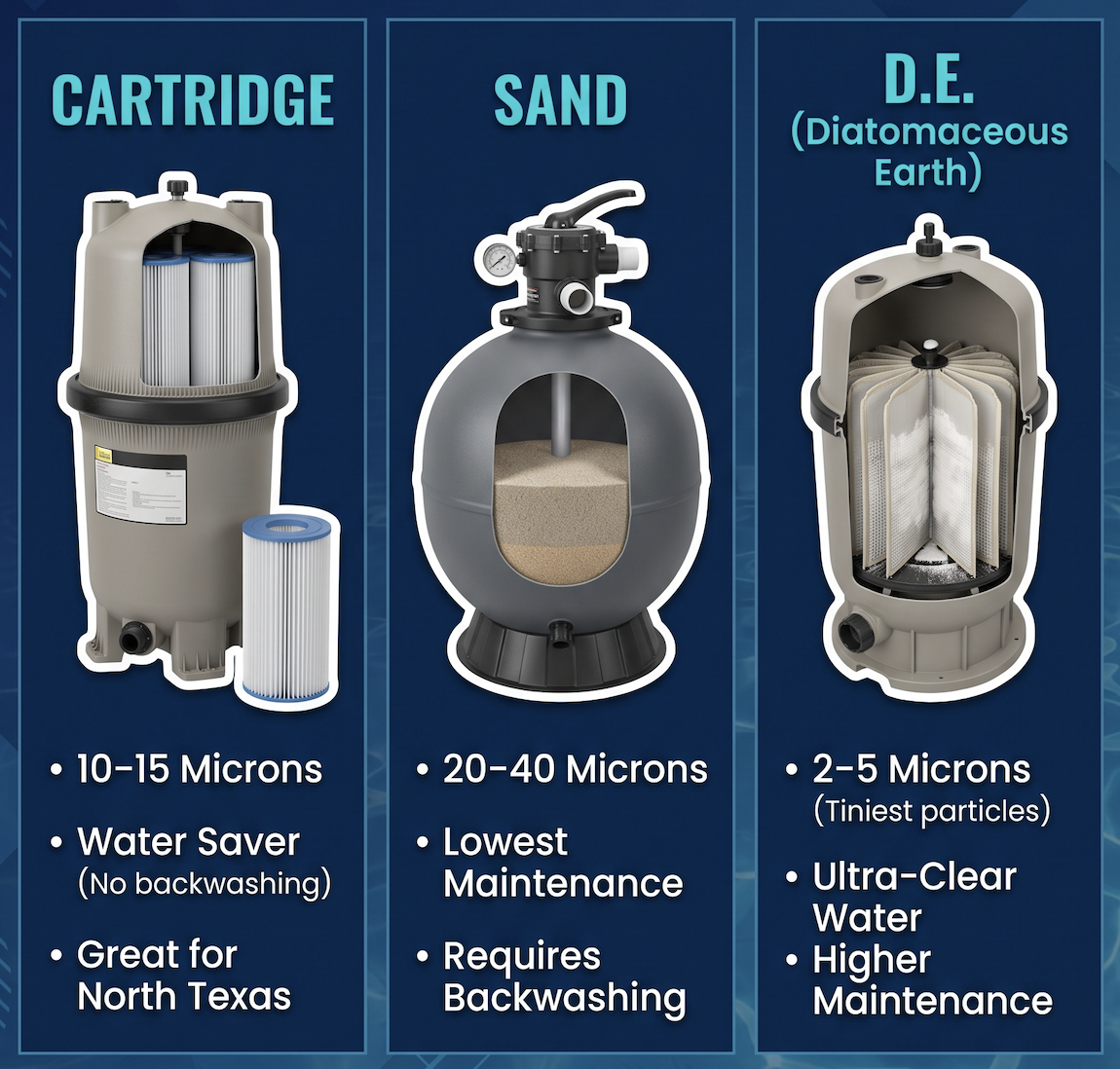

Your filter is the kidney of your pool — it pulls out the fine debris your skimmer misses. When it’s dirty, everything suffers: circulation drops, chemicals work harder, and the water goes cloudy. The catch is that the three common filter types are cleaned very differently. Here’s how to clean each one, how often, and how to tell yours needs it. Noah’s Pool Service checks and services filters as part of weekly care.
How to tell your filter needs cleaning
The clearest signal is your pressure gauge: when it reads about 8–10 PSI above the clean/starting pressure, it’s time. Other signs are weaker return jets, cloudy water that won’t clear despite balanced chemistry, and longer run times to get the same result. Waiting too long strains the pump and lets fine debris recirculate.
Cartridge filters
Turn off the pump, relieve pressure, and remove the cartridge(s). Rinse top to bottom with a hose to work debris out of the pleats — a spray nozzle helps. For oils and buildup, soak the cartridge in a filter cleaner (never household bleach or detergent) and rinse again. Replace worn or flattened cartridges. Most cartridges want a rinse every few weeks in season and a deep soak periodically.
DE (diatomaceous earth) filters
Backwash to flush the old DE, then add fresh DE through the skimmer per your filter’s charge amount. Grids should be pulled and cleaned periodically, and DE filters typically need a full teardown once or twice a year. DE handles the finest particles of the three, but it’s the most involved to maintain.
Sand filters
Backwash by switching the valve to “backwash,” running until the sight glass runs clear, then “rinse,” then back to “filter.” The sand itself lasts years but eventually channels and needs replacing (usually every 5–7 years). Sand is the simplest to maintain but filters the least finely.
A note on frequency
Cleaning schedule depends on your filter type, pool use, and the season — heavy summer use and storms mean more frequent cleaning. If you’d rather not track pressure gauges and DE charges, filter checks are part of our weekly service, and you can see the full routine on our weekly checklist.
Frequently asked questions
How often should I clean my pool filter?
Clean it when the pressure gauge reads about 8–10 PSI above its clean starting pressure. In practice that’s every few weeks to a couple of months depending on filter type, pool use, and season — more often in heavy summer use or after storms.
How do I clean a cartridge pool filter?
Turn off the pump, remove the cartridge, and rinse it top to bottom with a hose to clear the pleats. For oils and buildup, soak it in a dedicated filter cleaner (never bleach or detergent), rinse again, and replace worn cartridges.
How do I clean a DE or sand filter?
Both are cleaned by backwashing: run the valve to backwash until the water runs clear, then rinse, then return to filter. DE filters also need fresh DE added afterward and a periodic full teardown; sand filters need the sand replaced every 5–7 years.
What happens if I don’t clean my pool filter?
Circulation drops, the pump works harder, chemicals become less effective, and the water turns cloudy. A neglected filter can also shorten pump life. Cleaning on schedule keeps water clear and equipment healthy.
How do I know which filter type I have?
Check the tank: cartridge filters open to reveal pleated cartridges, DE filters use grids and a powdered media added through the skimmer, and sand filters have a multiport valve on top with ‘backwash’ and ‘rinse’ settings. When in doubt, a pool tech can identify it in seconds.
What are microns, and why do they matter for pool filters?
A micron (one-millionth of a meter) measures how finely a filter cleans your pool water. The lower the micron rating, the smaller the particles your filter traps:
- Sand filters (20–40 microns): Catch visible debris and coarse dirt.
- Cartridge filters (10–15 microns): Trap fine dust, pollen, and debris well below human eye visibility without backwashing.
- D.E. filters (2–5 microns): Trap microscopic particles for maximum clarity.